Your department is tasked with keeping medical equipment in proper working condition. It’s a big job with life and death consequences. One of the best ways to keep your devices in good shape while staying focused on patient safety is to partner with a third-party provider on repairs.
While that idea makes sense to you and your team, convincing hospital leadership can be a challenge. Leaders often believe device repairs is the explicit responsibility of your department. Technically, that’s true. But we know you can only take on so much. Working with a reputable repair partner ultimately saves time and money.
How can you convince hospital leadership that medical device repairs is a smart move? Let us help you make the case for repairs.
The Rising Cost of New Equipment
The cost of supplies and equipment is increasing, and hospitals across the country are feeling the budgetary pinch.
According to the American Hospital Association, “total spending on supplies increased 9.9% through 2025, reflecting higher prices for everything from basic medical disposable gloves to pacemakers, ventilators and other technology that clinicians rely on every day.”
An AHA analysis from 2024 also found hospitals spent more than $10 billion on surgical and medical instruments alone – that’s a more than 7% increase from 2023.
When you can repair devices and defer the cost of buying new equipment, hospitals could save hundreds of thousands of dollars.
A small sampling of hospital executives found 40% are planning to cut or defer capital equipment spending due to tariffs, higher interest rates, and threats to Medicaid.

In this kind of budget environment, the ability to extend device life through high-quality repair is a competitive and financial imperative.
Crunch the Numbers: Equipment Repair Saves Money
Repairs are a cost effective way to extend the life of a device. If your equipment is just a few years old, a repair can be significantly less than the cost of a brand-new device.
Repairing devices also ensures they stay in good working condition. Our repair technicians can catch any other issues. And they test each device to ensure it’s working properly before sending it back to your facility.
Devices that are well maintained will last longer and experience fewer failures and breakdowns.
When comparing repair to replacement, encourage leadership to evaluate Total Cost of Ownership, which includes:
- Purchase/repair price (parts + labor)
- Installation, training, and onboarding costs
- Maintenance contract costs over full useful life
- Revenue generated or preserved per year of use
- Residual/salvage value
Focus on more than the repair price. Evaluate the full replacement cost – installation, training, and ramp-up. Otherwise, you’re significantly underestimating the value of the medical device repair.
Don’t forget to factor in the length of the OEM warranty. It’s likely shorter than the full lifespan of the device.
Eliminate Equipment Downtime with Fast Third-Party Repairs
While your team of biomedical professionals are well versed in healthcare technology, they likely don’t know the ins and outs of every single device.
Our repair techs are highly skilled and well trained. They have vast experience working on a variety of different devices and models. They aren’t easily stumped.
While your team members can certainly get up to speed on a repair, is that the best use of their time? They’re watching videos, reading manuals, and engaging in time-consuming trial and error. All the while, your facility is going without the equipment it needs.
Instead, ship your device off to our team. We can quickly diagnose and repair the device. Our normal turnaround time is 5 to 7 business days – reducing device downtime.
While we’re fixing your equipment, your team can focus on preventive maintenance, day-to-day operations, and overall patient safety.
A report from Houlihan Lokey notes, “As the complexity of medical devices continues to grow, outsourcing ensures that healthcare facilities can access up-to-date repair techniques
without the need for continuous in-house training.”
The report goes on to note outsourcing repairs allows hospitals and medical facilities to “enhance operational efficiency, reduce equipment lifecycle costs, and ultimately deliver better patient care.”
Regulatory Environment Makes Repairs a Viable – and Safe – Option
Hospital leaders often object to third-party repairs based on concerns about patient safety and compliance. Those concerns are unfounded – especially when you look at regulatory reports.
In 2018, the FDA issued a report noting “many OEMs and third party entities provide high
quality, safe, and effective servicing of medical devices.”
The report also highlighted the fact “continued availability of third-party entities to service and repair medical devices is critical to the functioning of the U.S. healthcare system.”
As a result, the FDA decided not to impose additional regulatory requirements.
Qualified repair — whether in-house or through a vetted ISO — is recognized as safe and effective by the FDA, provided it adheres to quality management principles.
At Sage Services, we take quality seriously. Each year, we go through an audit to maintain our dual certifications of ISO 9001 and ISO 13485.
Repair is not simply a cost-cutting tactic — it is a capital preservation strategy endorsed by the FDA, supported by Joint Commission standards, validated by market growth, and increasingly mandated by right-to-repair legislation.
When new equipment budgets are constrained or frozen, repair and life extension are not just cost-conscious — they are operationally necessary.
Build Your Case, Then Test the Process
You don’t have to send your entire fleet to a third-party partner to prove the model works. Start with one device. Track the turnaround time, the cost savings, and the quality of the repair. Bring that data back to leadership as a proof point.
Ready to see how the math works for your facility? Submit a repair request and start building your case.
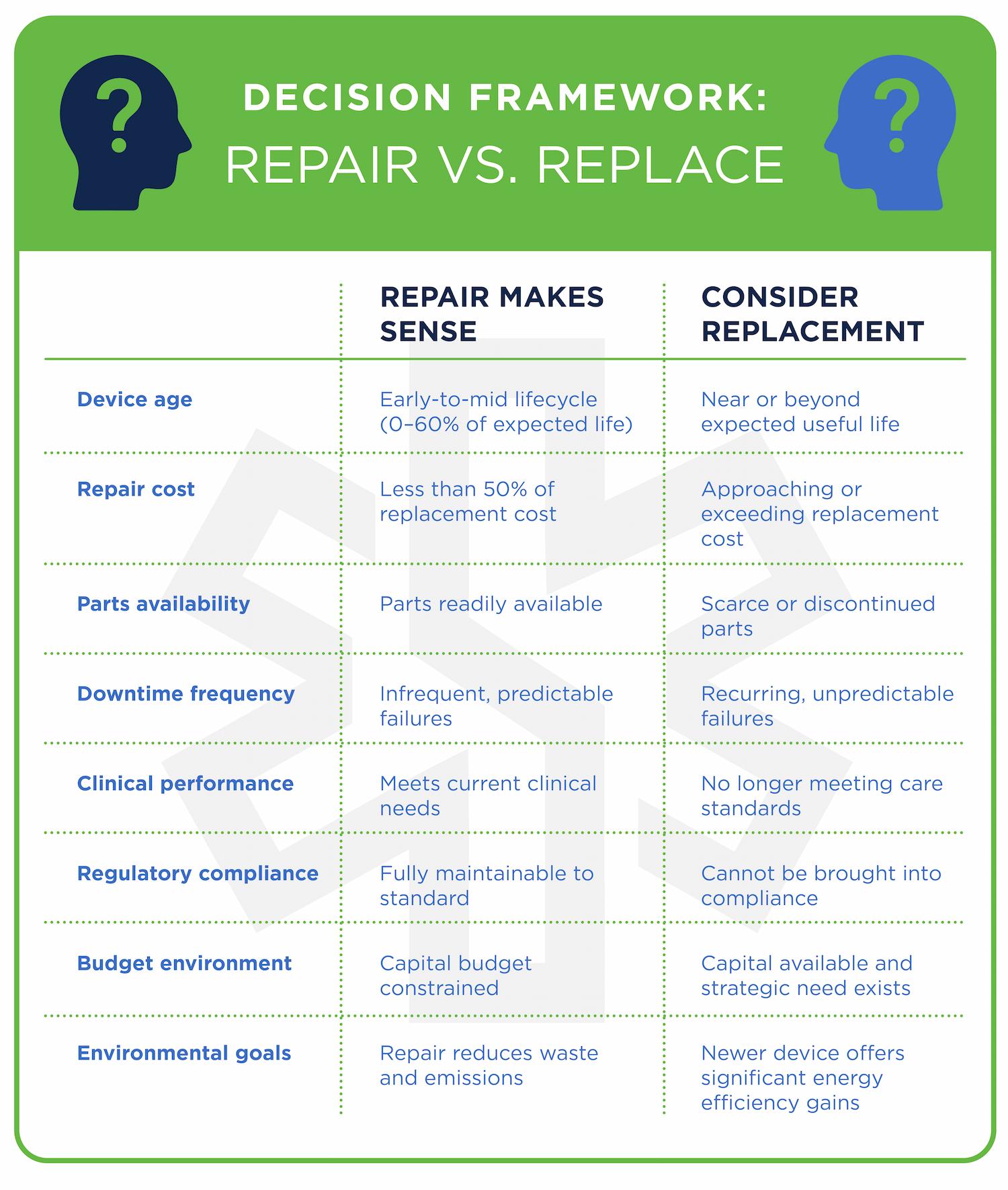
Need a little extra help convincing your CFO?
Here’s a decision framework you can use with hospital leadership to make the case for repairs.
Frequently Asked Questions
Is third-party medical device repair FDA-approved?
The FDA does not formally “approve” individual repair providers, but its 2018 report on medical device servicing concluded that many third-party entities provide high-quality, safe, and effective service — and that their continued availability is critical to the U.S. healthcare system. The FDA chose not to impose additional regulatory requirements on third-party servicers, recognizing that qualified repair adheres to quality management principles. Hospital leaders evaluating a repair partner should look for ISO 9001 and ISO 13485 certifications, which demonstrate adherence to internationally recognized quality standards for medical devices.
How do I calculate Total Cost of Ownership for medical equipment?
Total Cost of Ownership (TCO) for medical equipment includes the purchase or repair price (parts plus labor), installation, training, and onboarding costs, maintenance contract costs over the device’s full useful life, revenue generated or preserved per year of use, and residual or salvage value. Comparing only the repair price to a new device’s sticker price significantly underestimates the true cost of replacement. Factoring in the length of the OEM warranty — typically shorter than the full lifespan of the device — also strengthens the financial case for repair.
What certifications should a medical device repair company have?
A qualified medical device repair company should hold ISO 9001 certification (general quality management) and ISO 13485 certification (quality management specifically for medical devices). FDA registration is also an important credential. These certifications require annual audits and demonstrate that the provider adheres to documented quality processes when servicing medical equipment.
What is the typical turnaround time for third-party medical device repair?
Turnaround times vary by provider and device type, but a reputable third-party repair partner should be able to diagnose and complete most patient monitoring device repairs within 5 to 7 business days. Faster turnaround reduces equipment downtime and allows in-house biomedical teams to focus on preventive maintenance and patient safety rather than on time-consuming trial-and-error repairs.